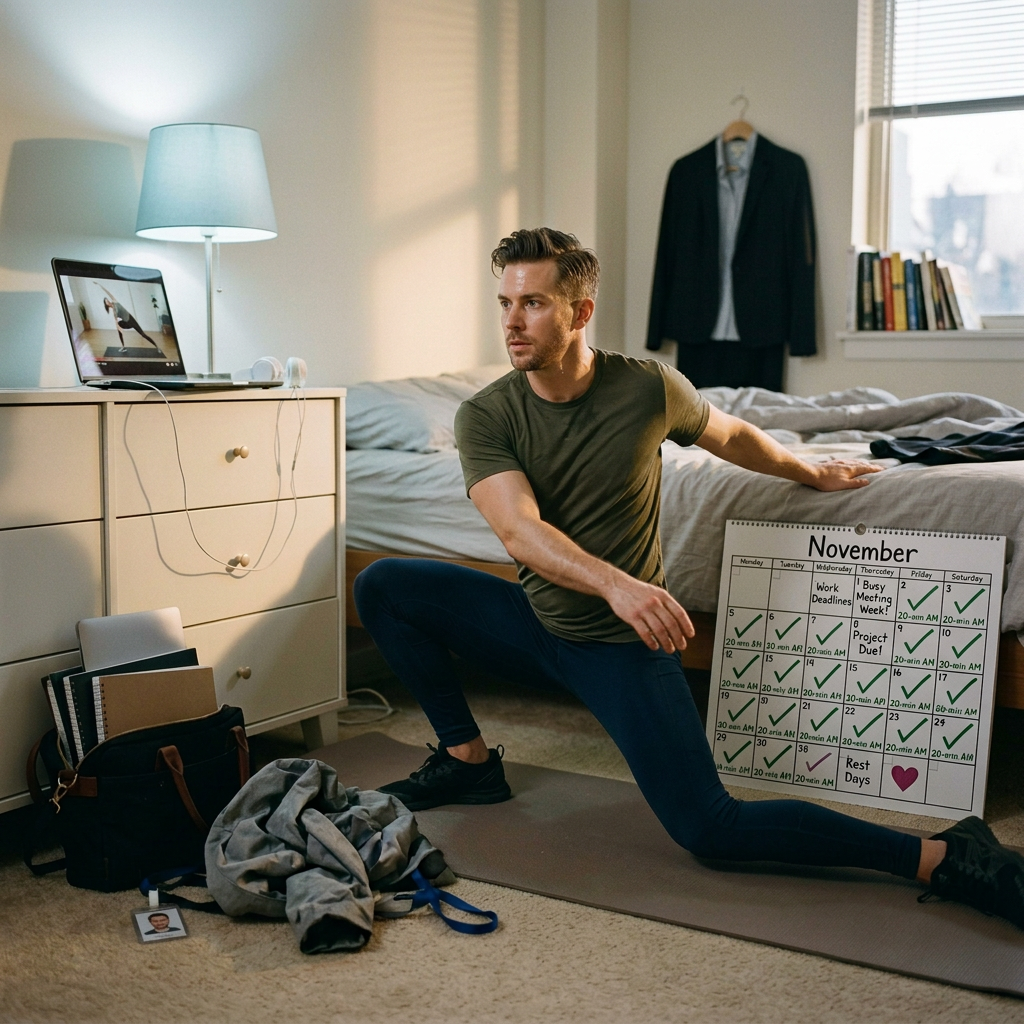
The Workout Habit That Survives a Busy Month
September has a way of changing your routine without asking permission.
The kids are back in school. Work gets busier. Meetings start filling up the calendar again. The workout time that was easy to protect during the summer suddenly disappears.
And that’s usually how people stop exercising.
Not because they decided to quit. They miss Monday. Then Wednesday gets pushed. The weekend gets busy. Before they realize it, several weeks have gone by without a proper workout.
The problem usually isn’t the exercise program.
It’s that the program was designed for a life that isn’t happening anymore.
Maybe you had four one-hour workouts planned every week. Warm-up, strength training, accessories, stretching. That’s a perfectly good routine when your schedule cooperates.
But what happens when it doesn’t?
That’s where having a minimum version of your workout can make all the difference.
Decide What Your Minimum Workout Looks Like
Before the month gets hectic, figure out the smallest workout you are willing to do.
Not your ideal workout.
Your minimum workout.
For some people, that might be 15 minutes at home. A few sets of squats, push-ups and a plank can be enough to keep you moving.
For someone in Montreal, it could mean taking the stairs or walking up Mount Royal instead of taking the easier route.
It doesn’t have to look like a traditional gym workout to count.
The important thing is having a fallback plan.
Think of your normal workout as the ceiling. That’s what you do when everything goes according to plan.
Your minimum workout is the floor.
When life gets busy, you don’t need to reach the ceiling every time. You just need to avoid falling through the floor.
Don’t Let Three Missed Days Become a Habit
Missing one workout isn’t a big deal.
Missing two isn’t the end of the world either.
But three can start to become a pattern.
That’s why I like a simple rule: don’t go three days without doing something.
It doesn’t have to be a full strength-training session. If your schedule is a mess, do your minimum workout.
Even 10 or 15 minutes is better than deciding you’ll start again next Monday.
The goal isn’t perfection.
It’s consistency.
Whether your goal is improving fitness, building strength, losing weight, improving mobility or simply becoming more active, consistency matters more than having a perfect week every week.
Move the Workout Instead of Deleting It
One of the easiest mistakes to make is cancelling a workout because your normal training time no longer works.
You planned to exercise at 7 a.m., but a meeting was added.
So the workout gets pushed to the evening.
Then something else comes up.
Then you tell yourself you’ll make it up on Saturday.
Saturday arrives, and now you’re trying to catch up on everything else you didn’t get done during the week.
Instead, move the workout.
If you can’t train in the morning, train at lunch.
If lunch doesn’t work, exercise at home in the evening.
If you only have 15 minutes, do 15 minutes.
Your workout doesn’t have to be all or nothing.
There can be a 60-minute version, a 30-minute version and a 15-minute version.
On a busy week, shrinking the workout is completely fine.
Eliminating it altogether is what makes getting back into the routine harder.
Don’t Try to Make Up for Lost Time
Busy periods aren’t the best time to chase personal records.
If you’re sleeping less, eating differently and dealing with more stress, your body is already dealing with a heavier load.
That doesn’t mean you should stop strength training.
It means you should be smart about it.
Keep the weights reasonable. You might do three sets instead of five. Keep your effort around a 7 out of 10 rather than trying to push every set to the limit.
And there’s no need to introduce a bunch of new exercises.
Stick with movements you already know.
The goal during a stressful month isn’t to become dramatically stronger.
The goal is to make it through the month still training.
You can worry about increasing strength and intensity when life settles down.
The same idea applies to high-intensity interval training.
If you’re already exhausted from work and haven’t slept well, another hard HIIT workout may not be the best choice. A shorter strength session, a walk or some mobility work may be a better option.
And don’t automatically throw out stretching or mobility training because it doesn’t feel like a “real” workout.
Ten minutes of mobility work on Sunday evening is still useful.
Sometimes the easiest session to skip is the one that would have been easiest to complete.
What If You Actually Miss an Entire Week?
Eventually, it will happen.
Work gets crazy. Someone gets sick. You travel. Life happens.
Don’t turn one missed week into a reason to start over.
You don’t need to punish yourself with a two-hour workout.
You don’t need to double your training the following week.
Just start again.
Do a shorter workout the first time back. Use slightly lighter weights than you were using before the break. Give yourself a couple of sessions to get your rhythm back.
Then continue normally.
One missed week shouldn’t become one missed month.
Build a Workout Plan for Your Real Life
One of the biggest lessons I’ve learned through fitness is that the people who stay active for years aren’t necessarily the people with the most complicated programs.
They’re usually the people who know how to adapt.
They have a normal workout for normal days.
They have a shorter workout for busy days.
And they have a minimum version for the days when everything goes wrong.
That’s what makes a fitness routine sustainable.
You don’t need to win every week.
You just need to keep showing up.
So before your next busy month starts, decide what your workout floor looks like.
Write it down.
Because when the calendar gets crazy, you don’t want to have to decide whether to exercise.
You want to already know what to do.
Fawaz Sebai has been training people in Montreal since 2021, in person and online, and the ones who lost weight and still have it off years later are, without much exception, the ones who lifted through the whole process rather than adding it at the end.
If you want help putting a two-day plan together around whatever your week already looks like, get in touch.
Leave a Reply