Seven weeks into a plan, the squat is moving up in small jumps, the sessions feel routine, and that’s the week someone decides the program has gone stale. New plan. Fresh spreadsheet. Back to week one of something else.
That decision is the most common reason people train for years without getting much stronger. Not effort. Not form. Just restarting, over and over, so nothing is ever given long enough to do its work.
Boredom isn’t a training signal
A program that feels boring in week six is usually a program that’s working.
The first two weeks of anything new feel productive because everything is unfamiliar. You’re sore in places you weren’t before, you’re concentrating hard on the movement, and your sessions take longer because you’re thinking. That feeling is you learning a movement pattern. It isn’t your body changing.
The change shows up later, in the stretch where nothing feels new and the bar is quietly 15 kilos heavier than it was a month ago. Those are the weeks people quit on, because the sessions stop being interesting right around the time they start being useful.
So the question isn’t whether you’re bored with the program. It’s whether the numbers are still moving.
How often to change your workout program
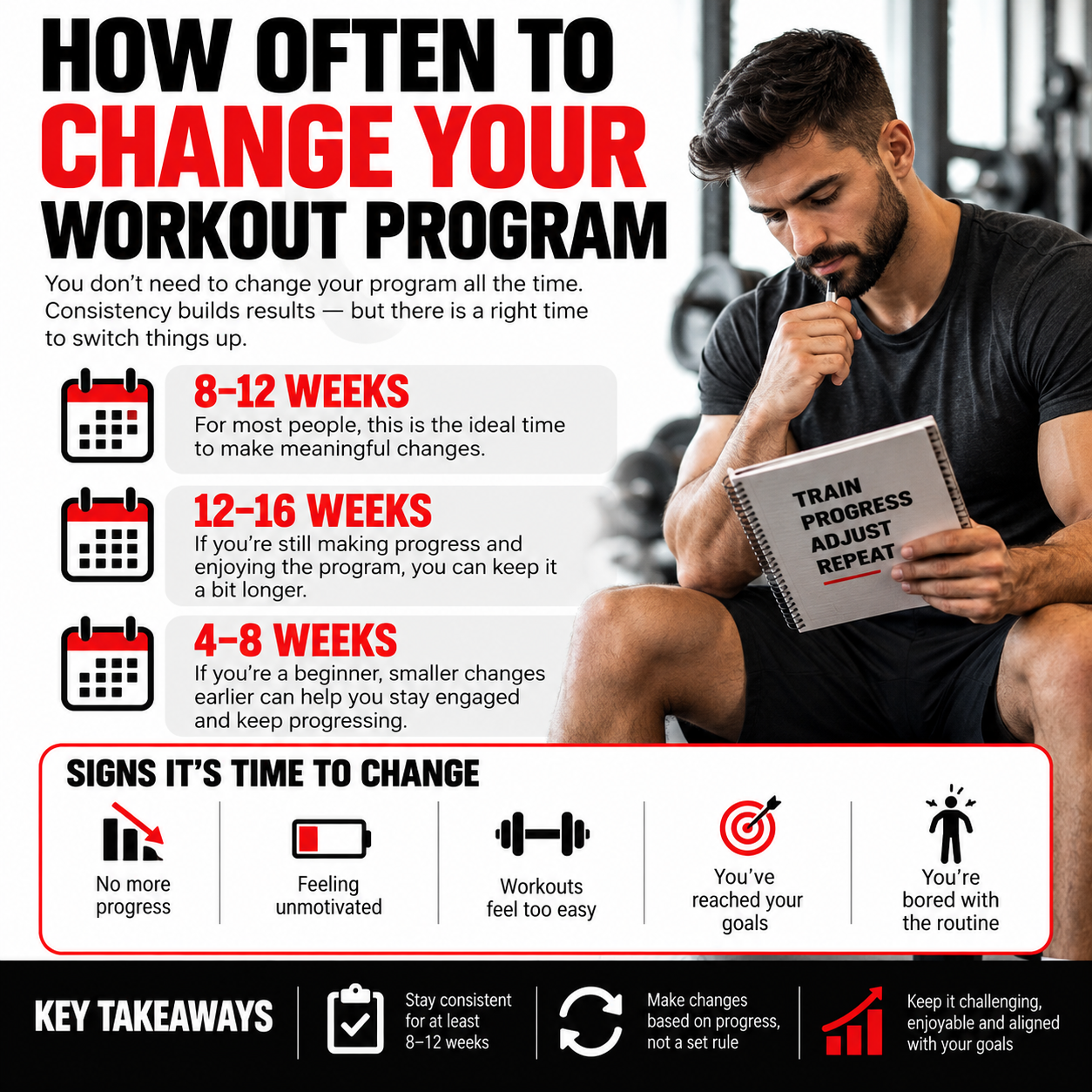
Eight to twelve weeks on the same main lifts, for most people. That’s the honest answer.
Inside that block, the individual lifts tell you when they’re finished. If you’ve added weight or reps to your squat in two of the last three sessions, the squat is not stale, however you feel about it. If you’ve been stuck at the same working weight for three or four sessions in a row, and your sleep and food haven’t fallen apart that week, that lift has stopped giving and it’s worth adjusting.
Note that this is per lift, not per program. Your press can stall while your deadlift is still climbing. People throw out the whole plan because one exercise flatlined, which is like replacing a car over one tire.
Beginners get a longer runway. If you’ve been training under six months, the same four or five movements will keep paying for a long time, because almost everything you gain in that period comes from doing a small number of things repeatedly and getting better at them. Trading that in for variety is the single most expensive mistake a new lifter makes.
Change the variable, not the program
When a lift genuinely stalls, the fix is almost always smaller than people want it to be. In order of how little disruption they cause:
- Load. Smaller jumps. Microplates exist, and 1 kilo per side every two weeks beats 5 kilos that you miss.
- Reps. Move from sets of 5 to sets of 8 at a lighter weight for a few weeks, then come back.
- Volume. Three working sets instead of five, or the reverse, depending on which direction you’ve been grinding.
- Rest. Two to three minutes between heavy sets. Most people stalling on strength are resting ninety seconds and calling it a plateau.
- Exercise variation. Front squat instead of back squat. Incline instead of flat. Same pattern, different angle, and you keep every bit of the skill you built.
Work down that list before you touch anything else. It usually takes one of them.
When starting over is right
Four reasons to scrap a program properly.
Something hurts in a way that doesn’t warm up and go away. Your schedule has changed in a real way, four days becoming two means the plan has to be rebuilt rather than trimmed. Your equipment changed, which happens here every January when people switch gyms and discover the new place has no trap bar. Or your goal changed, and the program is now built for something you no longer want.
Boredom isn’t on that list. Neither is seeing a different split on Instagram.
The part nobody likes
Training that works is repetitive. Three sets of five on the same lift, week after week, with the weight creeping up, is what progress actually looks like from the inside, and it looks like nothing much at all. Variety feels like effort. Repetition is effort.
Keep the novelty for the stuff where it costs you nothing. Add a yoga session between your hard days, take the Mount Royal stairs when the weather allows it, change the music. Leave the main lifts alone and let them get heavy.
I’ve been coaching in Montreal since 2021, in person and online, and the clients who get the most out of a block are the ones who stop renegotiating it every three weeks. Give a program twelve weeks before you judge it.
If you’re not sure whether your current program has stopped working or you’ve just stopped enjoying it, send me the last month of your training log and I’ll tell you which one it is.