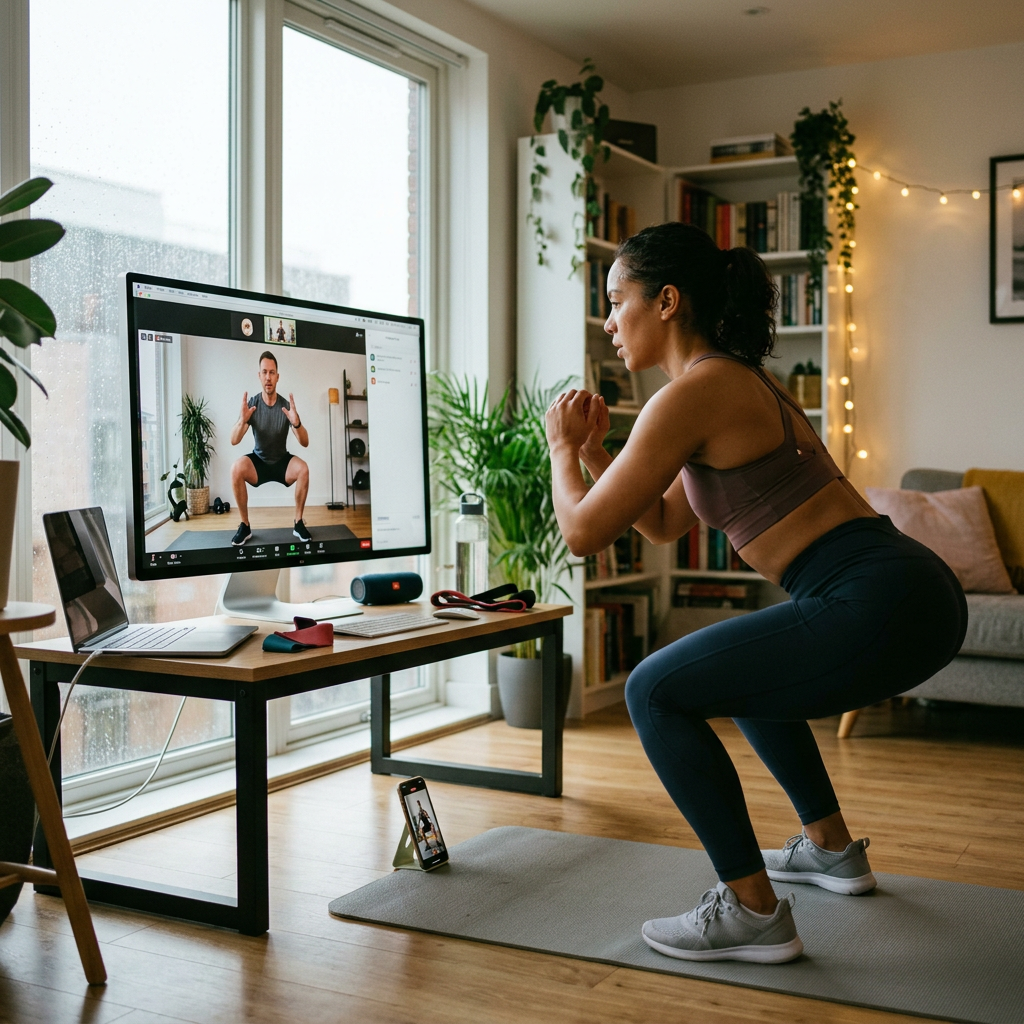
February is when the online coaching questions start.
The drive stops being worth it. A forty-five minute session turns into ninety with parking, brushing off the car, and the crawl up Décarie. People start wondering whether they could do this at home instead, with someone checking in on them.
They can. But the honest version of that answer has edges on it, and the edges sit somewhere most people don’t expect.
The first six weeks are where the real gap is
In person I can fix a squat in about ten seconds. Hand on the upper back, one cue about pushing the floor away, and you feel the difference on the next rep. Online, that same correction costs a video from you, a written reply from me, and a second video the week after to confirm it stuck. Ten seconds becomes six days.
If you have never held a barbell, that delay stacks up. You spend a week repeating something slightly wrong before anybody tells you. At the loads a beginner is using it’s almost never a safety problem. It’s a speed problem. And being slow in month one is what makes people quit in month two.
So here’s my position. If you have never trained and you can physically get yourself into a room with a coach in it, start there. Six to eight weeks. Learn the squat, the hinge, the press, the row, and what a genuinely hard set of eight feels like next to one you stopped early out of politeness. Then move online if that fits your life better. After those weeks the difference between the two formats gets very small.
What doesn’t change
The program.
Which is most of it, honestly. Whether you get stronger or lose weight is decided by what’s written down and whether you do it. That file is identical either way. Same progression, same rep ranges, same exercise order, same deload week when your sleep collapses during a work crunch. Nobody has ever built muscle out of proximity.
The accountability argument runs backwards
The usual pitch for in-person training is that you’ll show up because you paid and somebody is waiting for you. True, as far as it goes. It also stops working the day you stop paying, which is why people who trained in person for a year sometimes can’t get themselves through a single week alone.
Online builds the other habit first. You open the program, you read the session, you do it, you log it. Nobody sees you walk in. Nobody notices if you don’t. By month three that’s a skill that belongs to you rather than to your coach, and I think it’s the more useful one. It’s why I don’t treat online as the cheap version of the real thing.
The tradeoff is real though. Some people need the appointment. If you’ve started and stopped four times on your own, what you’re buying in person is a fixed point in your week more than it is coaching. Buy it. That’s a legitimate reason to pick the format.
Equipment decides more than the format does
This is the part that actually changes the program, and it has nothing to do with whether I’m standing there.
A pair of adjustable dumbbells that reach 50 pounds, a bench, and one resistance band covers most of what a general fitness or fat loss client needs for a year. Goblet squats, split squats, Romanian deadlifts, dumbbell presses, rows, all fine. You run them at 8 to 15 reps instead of heavy fives, because the load ceiling is lower and the reps have to make up the difference. HIIT needs nothing at all. Yoga needs a floor.
What you can’t do at home is load a heavy barbell squat or deadlift. If your goal is a bigger total, train in a gym. If your goal is to be leaner, stronger than you were, and still moving well at sixty, the home setup isn’t a compromise.
The most common mistake I see is somebody spending their entire home budget on a treadmill. You live in a city with a mountain in the middle of it. The stairs up Mount Royal are free and they are harder than the treadmill you’ll stop using in March. Buy the dumbbells.
Picking one
If you’re new and you can get to a gym with a coach in it, go in person for two months, then decide again.
If you’ve trained before and your problem is time, geography, or a schedule that moves every week, go online. You’ll lose almost nothing.
If you’re somewhere between the two, hybrid works better than people give it credit for. Online programming, in person once or twice a month to check the lifts that matter. That’s the setup I’d pick for most people who ask me.
I’ve coached both ways since 2021, in gyms across Montreal and with people I’ve never met in person, and the results don’t sort themselves by format. They sort by who did the work.
Closing CTA: If you want a program built around what you actually have access to, get in touch and we’ll work out which version fits.
Leave a Reply