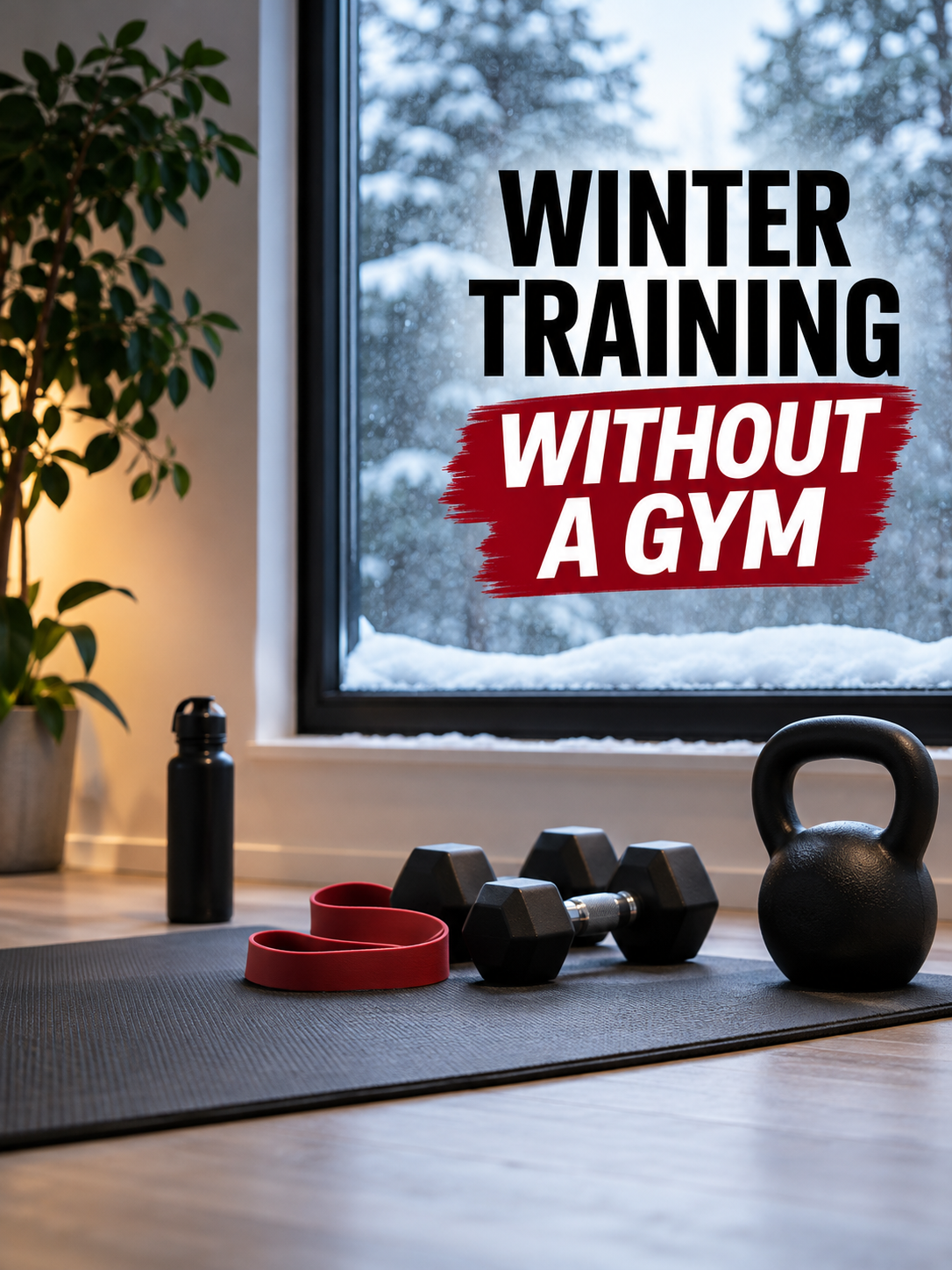
The first real cold week in Montreal is the last training week of the year for a lot of people. Not because of the weather. Because the gym is twenty minutes away, and twenty minutes stops being nothing once it is minus twelve and there is ice under the snow on the sidewalk.
So the question I get every November is whether it is worth setting something up at home, or whether to write off a few months and start again in March. Starting again in March is worse than it sounds. Four months off takes most of the strength built over the summer, and most of the habit with it. A home setup does not need to replace a gym. It needs to keep you training until April.
What you actually need to own
Less than people think, and almost none of what gets advertised in December.
A set of adjustable dumbbells covers most of it. If those are out of budget, two kettlebells will run a full program for a year, something around 16kg and 24kg for most men, 8kg and 16kg for most women. A pull-up bar that mounts in a doorframe costs about thirty dollars and is the best thirty dollars anyone with a small apartment will spend. One or two resistance bands for rows. That is the list.
What you do not need: a bench, a rack, a mirror, a treadmill, or anything with a subscription attached to it. The treadmill especially. In a Montreal apartment it ends up as a drying rack by February, and it cost two thousand dollars to become one.
Structuring the week when the gym is not the anchor
At a gym the building does the scheduling. You go, you train, you leave, and the session has edges. At home there are no edges, which is why home programs dissolve. Ten minutes here, a set between emails, and after three weeks you could not say what you had actually done.
The fix is to write three sessions and repeat them. Not four. Not something different every day.
- Session A: goblet squats, push-ups, single-leg hip hinge, hard plank. Four rounds.
- Session B: pull-ups or band rows, split squats, overhead press, loaded carries. Four rounds.
- Session C: whichever of the two felt worse last time, run again.
Thirty to forty minutes, three times a week, the same three sessions through to spring. The repetition is the point. You can only tell whether you are getting stronger if the workout stops changing underneath you.
Progression when you can’t add weight
This is where home training actually breaks, and it has nothing to do with motivation. At a gym you add five pounds. At home you own what you own, and six weeks in, the 16kg feels like a warm-up.
Three ways around it. Slow the lowering phase to three or four seconds, which makes the same weight significantly harder without changing anything you own. Cut fifteen seconds off your rest between rounds each week. Or move to a harder version of the movement: two-leg squat to split squat to rear-foot elevated split squat, push-up to feet-elevated push-up to one arm doing most of the work. Each of those steps is a bigger jump than adding a plate would have been.
Write down what you did, on paper or in your phone, it does not matter which. Home training without a log is just moving around in your living room.
The outdoor part
Cold is not the obstacle people treat it as. Minus ten with no wind, dressed properly, is comfortable to run or walk in after the first five minutes. The stairs up the Mount Royal side of Peel are free, cleared most of the winter, and ten trips up is a serious conditioning session with zero equipment.
What stops people is darkness and wind, not temperature. Sunset lands before 4:30 by mid-December here. If outdoor work is part of your week, it has to go on a weekend morning or at lunch, because at 6pm in January you are not going. Plan for the person you will be that evening, not the one reading this now.
A yoga session on one of the off days does more for how the cold months feel than most people expect, particularly if you sit at a desk and your training is now happening in a room with low ceilings.
Where it falls apart
Three things, every winter.
The equipment goes in a closet. If the dumbbells are not visible from where you sit in the evening, they will not get used. Leave them out and accept that the living room looks like a gym for four months.
The sessions are too long. Somebody writes a sixty-five minute program in November, does it twice, and stops. Thirty minutes that happens beats an hour that doesn’t, and it is not close.
And the first missed week becomes the last one. Missing a week in winter is normal, everybody does it. The people still training in April are not the ones who never missed. They are the ones who started again on the Monday without turning it into a verdict on themselves.
I have been coaching in Montreal since 2021, in person and online, and the home setups that survive a winter are almost always the small ones. Small enough that a bad week cannot break them.
If you want a program built around the equipment you already have in the apartment, get in touch through the site and we can sort out what your winter actually looks like.
Leave a Reply